Jack Hepworth (University of Central Lancashire) reports on the Rebellion, Revolution, and Resistance in the Twentieth Century – Social Movements, Class, and Political Violence workshop hosted by Newcastle University and supported by the BAIS Events Fund.
With thanks to generous funding support from the British Association of Irish Studies, Newcastle University Labour and Society Research Group hosted a two-day workshop on Friday 4 and Saturday 5 October: Rebellion, Revolution and Resistance in the Twentieth Century – Social Movements, Class and Political Violence. BAIS generously supported travel and accommodation for one of the workshop’s keynotes, Professor Niall Ó Dochartaigh (NUI Galway).
The workshop featured keynotes from Professor Ó Dochartaigh and Professor Sarah Waters (Leeds), as well as eight papers from postgraduate and early career researchers. These papers spanned protest and revolutionary politics in Chile, Ireland, the USA, and beyond. Keynotes Professor Ó Dochartaigh and Professor Waters contributed thought-provoking research on, respectively, the micro-temporalities of protest, and situating workplace suicides as protests in neoliberal. The workshop benefited from engagement beyond the university: we were delighted to welcome colleagues from Tyneside Irish Centre and North East Labour History.
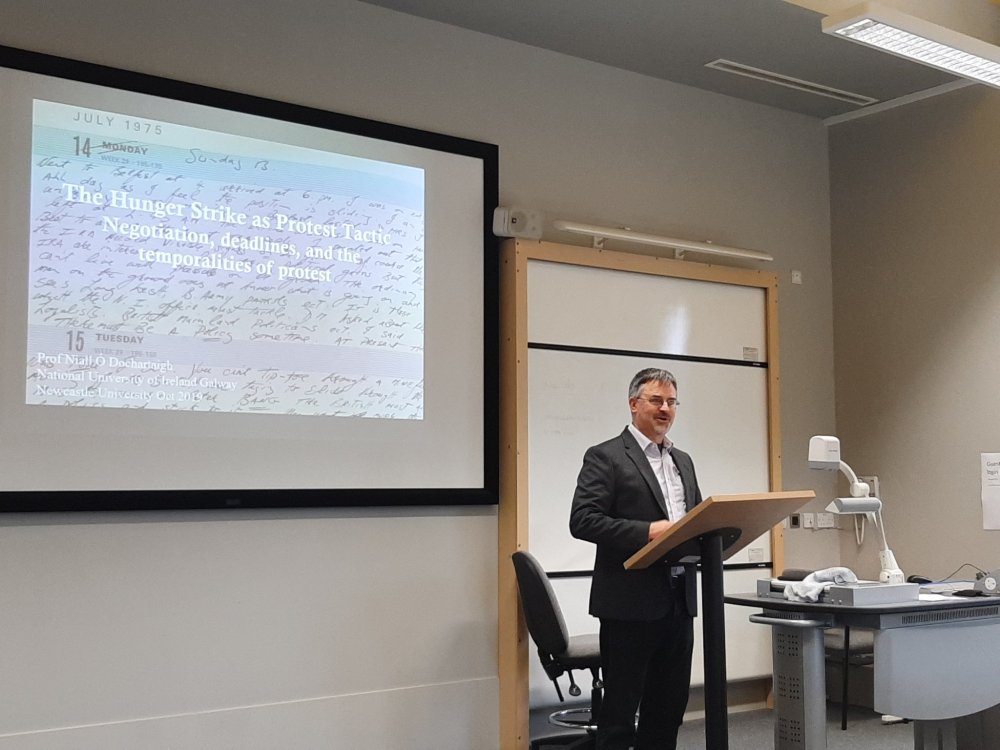
[Niall Ó Dochartaigh opens the workshop with his keynote on the temporalities of protest]
Keynote 1: Professor Niall Ó Dochartaigh (NUI Galway)
Professor Ó Dochartaigh explored the temporal dimensions of hunger strikes, and the collision of ‘institutional’ and ‘biological’ time. This paper explored the developments of hunger strikes from nineteenth-century Russia and the suffragette movement, through Cuba and Ireland, and accentuated the collective aspect of the bargaining which takes place against the intensive backdrop of a fast.

[Rowan Hartland discusses the politics of whiteface in theatre of the southern states of the USA]
Panel 1: Radicalism, racial politics and refugee activism
Joe Redmayne (Newcastle) analysed the regional construction of class in County Durham in 1919. Evaluating the utility of the category of the ‘white working class’, his paper assessed how ‘whiteness’ configured in labour militancy and rioting in post-Versailles riots and strikes in north-east England. Maria Vasquez-Aguilar (Sheffield) introduced her work on activists among the Chilean diaspora in Britain, challenging perceptions of refugees as passive victims. Her paper explored intergenerational transmission of ideas among Chilean migrants, especially through a second generation of protest against Pinochet from the late 1990s.
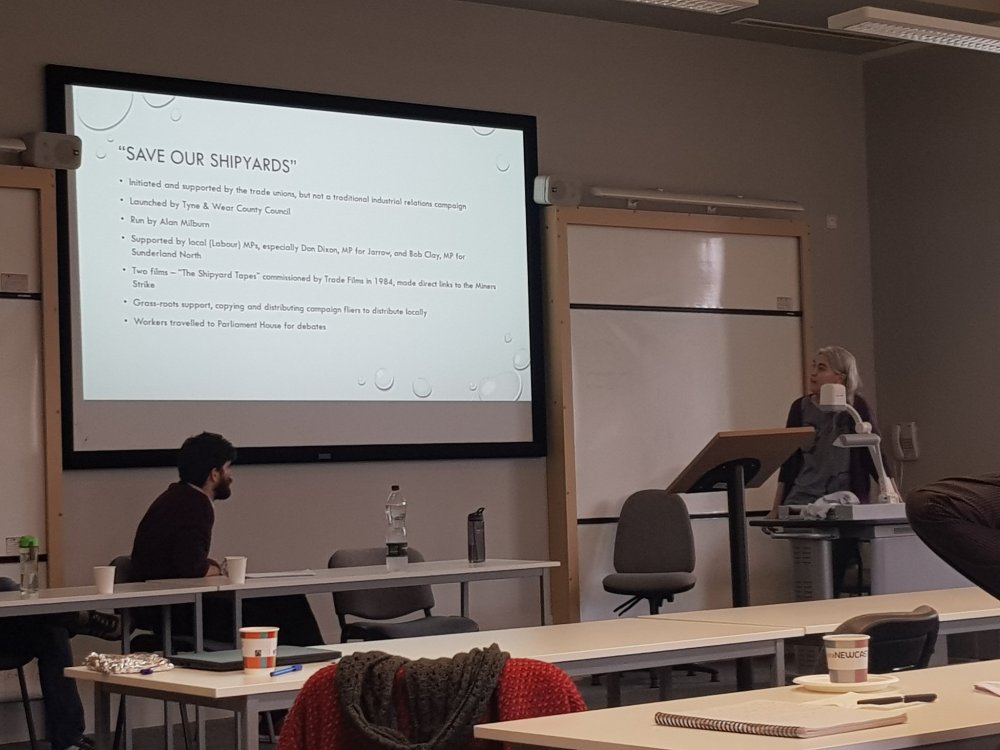
[Alison Atkinson-Phillips presents her work on memory of deindustrialisation in North-East England]
Panel 2: Radicalism and work
Ben Partridge (Newcastle) discussed the symbolic and tactic repertoires of strike photographers in France’s ’68, situating photography’s potential as an injustice frame to mobilise protest during what Walter Benjamin termed the ‘moment of danger’ or ‘historical rupture’. Rowan Hartland (Northumbria) presented work on the Free Southern Theater (FST) between 1964 and 1977. FST performed across the Deep South in this period, employing the radical performative strategy of ‘whiteface’ to challenge racial binaries. This paper also outlined the FST’s connections to the wider Black Power movement and its defiance of Ku Klux Klan attacks. Dr Alison Atkinson-Phillips (Newcastle) introduced oral histories recorded as part of a project exploring memory of deindustrialisation in the north-east of England. Her paper explored the potential of innovative stimulus-led methodologies to prompt recollection among former activists, inviting reflections more than three decades after their participation in Sunderland’s Save Our Shipyards campaign.
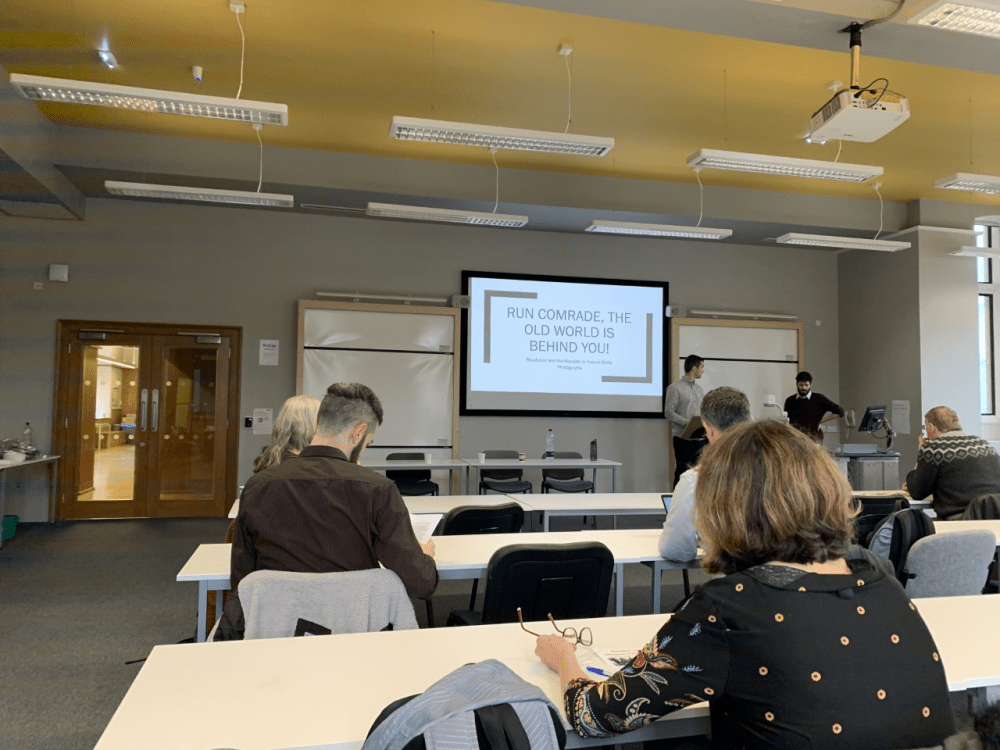
[Ben Partridge discusses photographic representations of strikes in France in May 1968]
Panel 3: Political violence in twentieth-century Ireland
Victoria Ball (Cambridge) opened this special interest panel with her work using oral history testimonies to explore women’s agencies in the Provisional IRA during the conflict in and about Northern Ireland. This paper assessed women’s multifaceted roles within the movement, and the particularities of collective memory of contentious politics. Emma Dewhirst’s (Liverpool) paper employed social movement theory concepts and primary research to consider the importance of kinship ties and intergenerational memory among republican activists during Ireland’s ‘revolutionary decade’ (1912-1923). Dr Jack Hepworth (University of Central Lancashire) assessed academics’ diverse approaches to writing Ireland’s twentieth-century political violence, charting how scholars’ treatment of militant activism has reflected, and responded to, shifting political realities nationally and internationally.
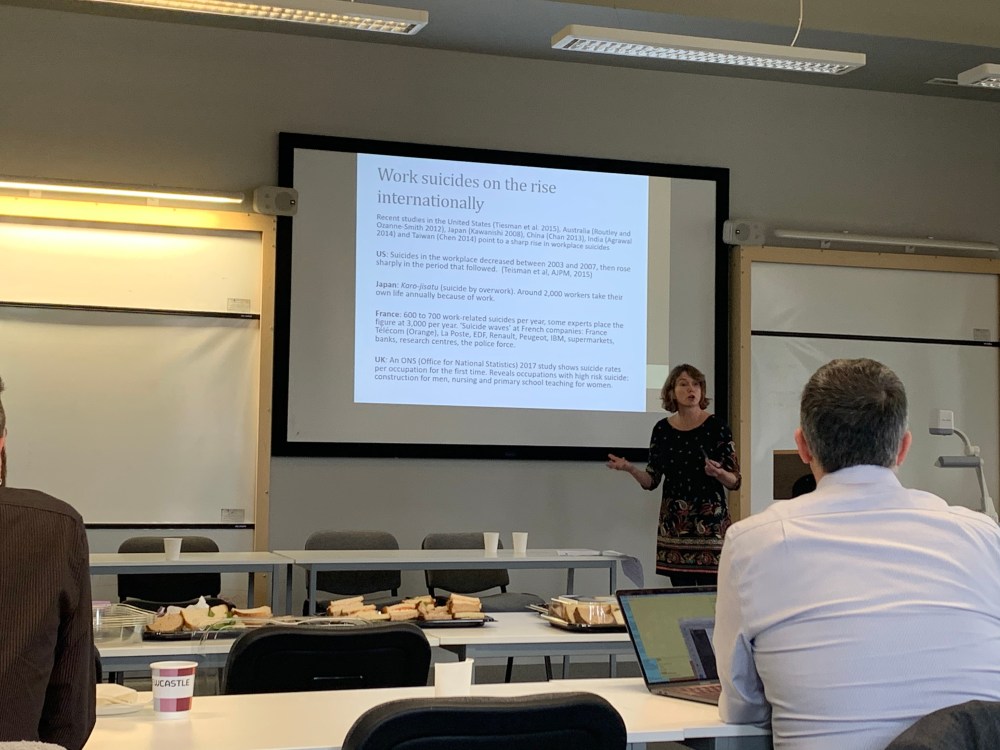
[Professor Sarah Waters closes the workshop by situating workplace suicides as protest in neoliberal France]
Keynote 2: Professor Sarah Waters (Leeds)
Professor Waters suggested the value of understanding workplace suicides in neoliberal France in the context of protest. For Professor Waters, suicides citing workplace pressures are simultaneously profoundly individual and collective: while the individual’s body becomes the ultimate site of resistance, there is a vital collective dimension to this response to systemic, institutional violence.
Jack Hepworth
University of Central Lancashire
jhepworth2@uclan.ac.uk
 British Association for Irish Studies